
Material Certificates in CNC Machining
Material certificates make it possible to verify the quality, composition, heat number, traceability and technical conformity of each machined part before it is integrated into a demanding industrial project.
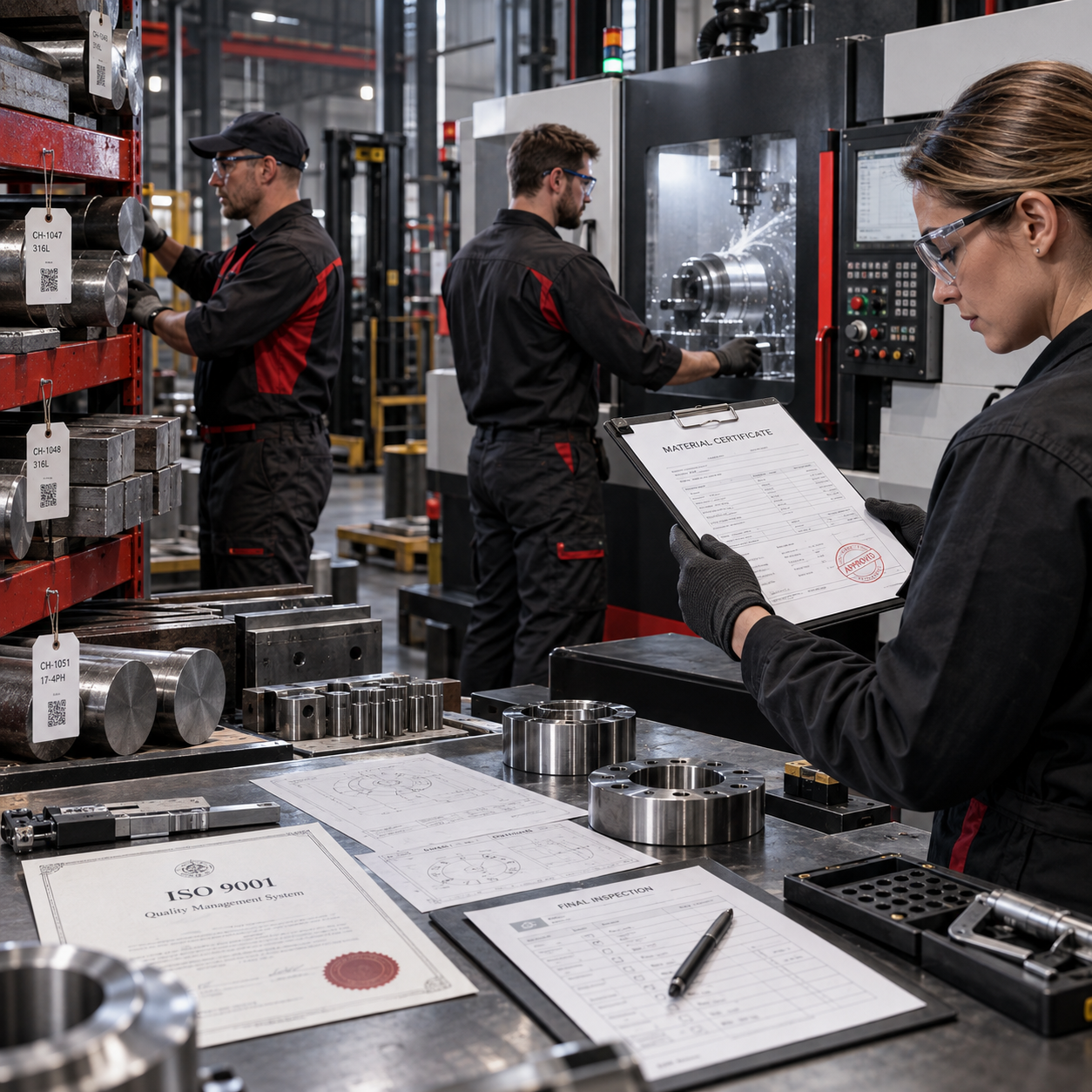
Why a material certificate is so important
In industrial machining, a part does not only need to have the correct shape. It must also be manufactured from the correct material, under the specified quality and with traceability that makes its origin identifiable.
The material certificate provides that documentary assurance. It allows data such as chemical composition, mechanical properties, heat number, applicable standard, dimensions, treatment and manufacturing batch to be checked.
Identifies the origin
Links each part to its heat number, batch or original supply.
Verifies quality
Confirms that the material matches the technical specification.
Reduces risk
Prevents failures caused by incorrect material, unsuitable composition or lack of control.
Supports audits
Provides documentation for inspections, approvals and quality systems.
Information the certificate should provide
A well-documented material certificate connects the physical part with verifiable technical information throughout the entire manufacturing process.
Certificate, traceability and industrial safety
Good machining is not enough
A part can be perfectly machined and still be invalid if the material does not match the required specification. In demanding sectors, a material error can cause premature failures, corrosion issues, loss of strength or rejection during an audit.
Traceability connects the entire process
From raw material to final delivery, traceability links certificates, drawings, batches, dimensional controls, treatments and finished parts. This turns each component into a documented part, not an anonymous item.
In professional machining, documentation is not an administrative extra: it is part of the technical value of the part.
From material to certified component
The certificate follows the process as a documentary thread. Each stage adds control, safety and technical evidence.
Material reception
Verification of quality, format, dimensions and received documentation.
Heat number verification
Connection between the physical batch, certificate and project specification.
CNC machining
Manufacturing according to drawing or standard while preserving material identification.
Final control
Dimensional and documentary review, plus preparation for customer delivery.
Technical certificate checklist
| Element | What it verifies | Why it matters |
|---|---|---|
| Material | Type of steel or alloy | Confirms that the part meets the drawing specification. |
| Heat number | Batch origin | Allows raw material to be traced during audits or incidents. |
| Chemical composition | Element percentages | Determines strength, corrosion behavior, weldability and performance. |
| Mechanical properties | Hardness, strength, yield limit | Indicates whether the material can withstand the assembly requirements. |
| Applicable standard | DIN, ASTM, ISO, EN or other | Defines technical requirements and acceptance criteria. |
| Treatment | Heat or surface treatment | Confirms additional processes that affect final performance. |
Without a certificate, the part loses technical value
Incorrect material
The wrong alloy can fail under load, temperature or corrosion.
No traceability
In the event of an incident, the batch and origin cannot be identified.
Audit rejection
Projects with quality requirements may reject undocumented parts.
Technical responsibility
Lack of documentary evidence makes it harder to justify work conformity.
Certificates within an ISO 9001 system
In a quality system, the material certificate is part of the manufacturing document control. It helps demonstrate that the part has been produced with identified, reviewed raw material aligned with the customer's requirements.
For machined components made from special steels, stainless steels, nickel alloys, duplex, superduplex or critical materials, this documentation is especially important because the material directly determines the service life of the part.
CNC machining with traceability and document control
At AREM-CNC, we work with certified materials, dimensional control, complete traceability and documentary support for machined parts made according to drawing or technical standard.