
ISO 4029 / DIN 916 HEXAGON SOCKET SET SCREW WITH CUP POINT
Technical guide to hexagon socket set screws with cup points, used for shaft fastening, component positioning and compact mechanical connections.
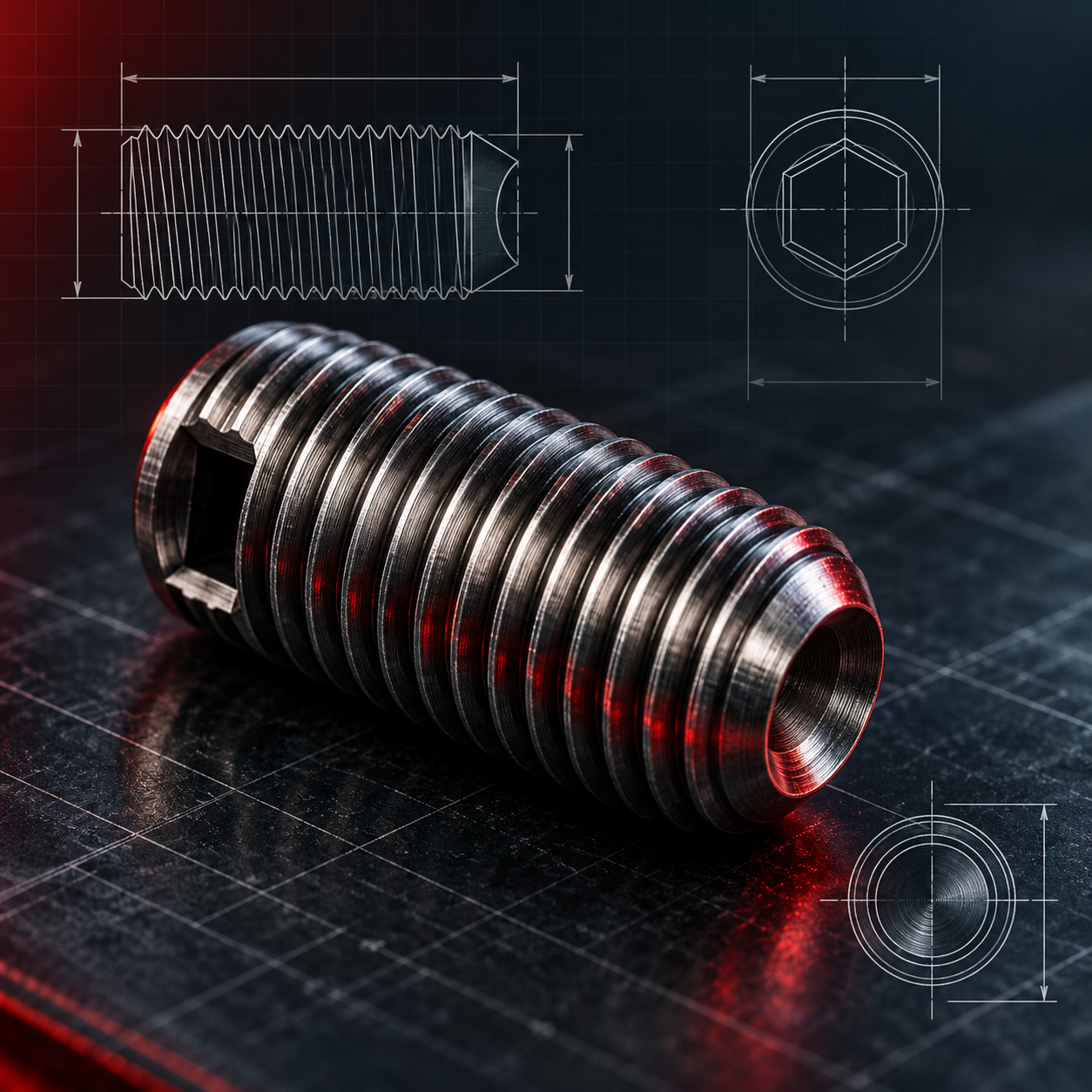
WHAT IS AN ISO 4029 SET SCREW?
The ISO 4029 set screw, traditionally designated as DIN 916, is a headless fastening component featuring an internal hexagon socket drive and a concave contact end known as a cup point.
This geometry allows localised contact with the surface of another component, such as a shaft, hub or transmission element, helping to restrict relative movement between parts.
Its compact design is particularly useful in assemblies where a protruding screw head is undesirable and a mechanical fastening solution accessible with a hexagon key is required.
ADVANTAGES OF CUP POINT SET SCREWS
LOCALISED CONTACT
The concave geometry provides a peripheral contact area that can improve component retention in suitable assemblies.
COMPACT INSTALLATION
The headless screw can be recessed within the component, preventing interference with surrounding mechanisms.
SHAFT FASTENING
Suitable for securing components mounted on shafts, including hubs, pulleys and certain mechanical transmission elements.
HEXAGON SOCKET DRIVE
The internal hexagon socket allows installation with compact tools and provides access in confined spaces.
TECHNICAL SPECIFICATIONS AND MATERIALS
ISO 4029:2026 specifies the characteristics of hexagon socket set screws with cup points, featuring metric coarse-pitch threads and product grade A.
Set screws are not intended to operate under tensile loads. Material selection, hardness, coating and tightening torque must be appropriate for the application and the relevant technical specification.
COMMON ISO 4029 / DIN 916 DIMENSIONS
The following table shows several commonly used metric thread diameters, including their standard coarse thread pitch and nominal hexagon socket size.
| THREAD | PITCH (mm) | HEX SOCKET (mm) |
|---|---|---|
| M3 | 0.50 | 1.5 |
| M4 | 0.70 | 2.0 |
| M5 | 0.80 | 2.5 |
| M6 | 1.00 | 3.0 |
| M8 | 1.25 | 4.0 |
| M10 | 1.50 | 5.0 |
| M12 | 1.75 | 6.0 |
Indicative table of commonly available commercial sizes. Complete lengths, tolerances and dimensional requirements should be verified against the applicable edition of the standard and the relevant technical drawing.
INDUSTRIAL APPLICATIONS OF CUP POINT SET SCREWS
This type of fastening component is used in mechanisms where two components must be secured in a fixed relative position through localised contact pressure.
DIFFERENCES BETWEEN SET SCREW POINT TYPES
FLAT POINT
Flat contact surface. Suitable for applications requiring contact without a protruding point.
CONE POINT
Concentrated contact at a pointed tip, allowing localised penetration into the mating surface.
DOG POINT
Protruding cylindrical end, suitable for specific positioning and locating applications.
CUP POINT
Concave end with peripheral contact, commonly used for securing shafts and mechanical components.
CUSTOM FASTENERS MADE TO DRAWING
When standard dimensions do not meet project requirements, made-to-drawing manufacturing solutions can be assessed, incorporating specific geometries, materials and technical characteristics.
FAQ ABOUT ISO 4029 / DIN 916
What does cup point mean?
A cup point is a concave screw end designed to establish peripheral contact with the surface of the component being secured.
Are ISO 4029 and DIN 916 equivalent?
DIN 916 is the historical designation associated with this type of set screw. For technical procurement, dimensions and the required standard edition should be verified.
Are these screws available in stainless steel?
Yes. Stainless steel versions are available, including A2 and A4 grades, alongside different steel options.
Can they be used to secure a shaft?
Yes. This is a common application, provided that the joint design, applied loads and tightening torque are suitable for the assembly.
Can AREM-CNC manufacture custom components?
Yes. You can submit a technical drawing or specification so that manufacturing feasibility, tolerances and material requirements can be assessed.
DO YOU NEED SET SCREWS OR CUSTOM MACHINED PARTS?
Send us your technical drawing, dimensions, quantities, material specifications and project requirements. We will assess the manufacturing options and the most suitable solution for your project.