
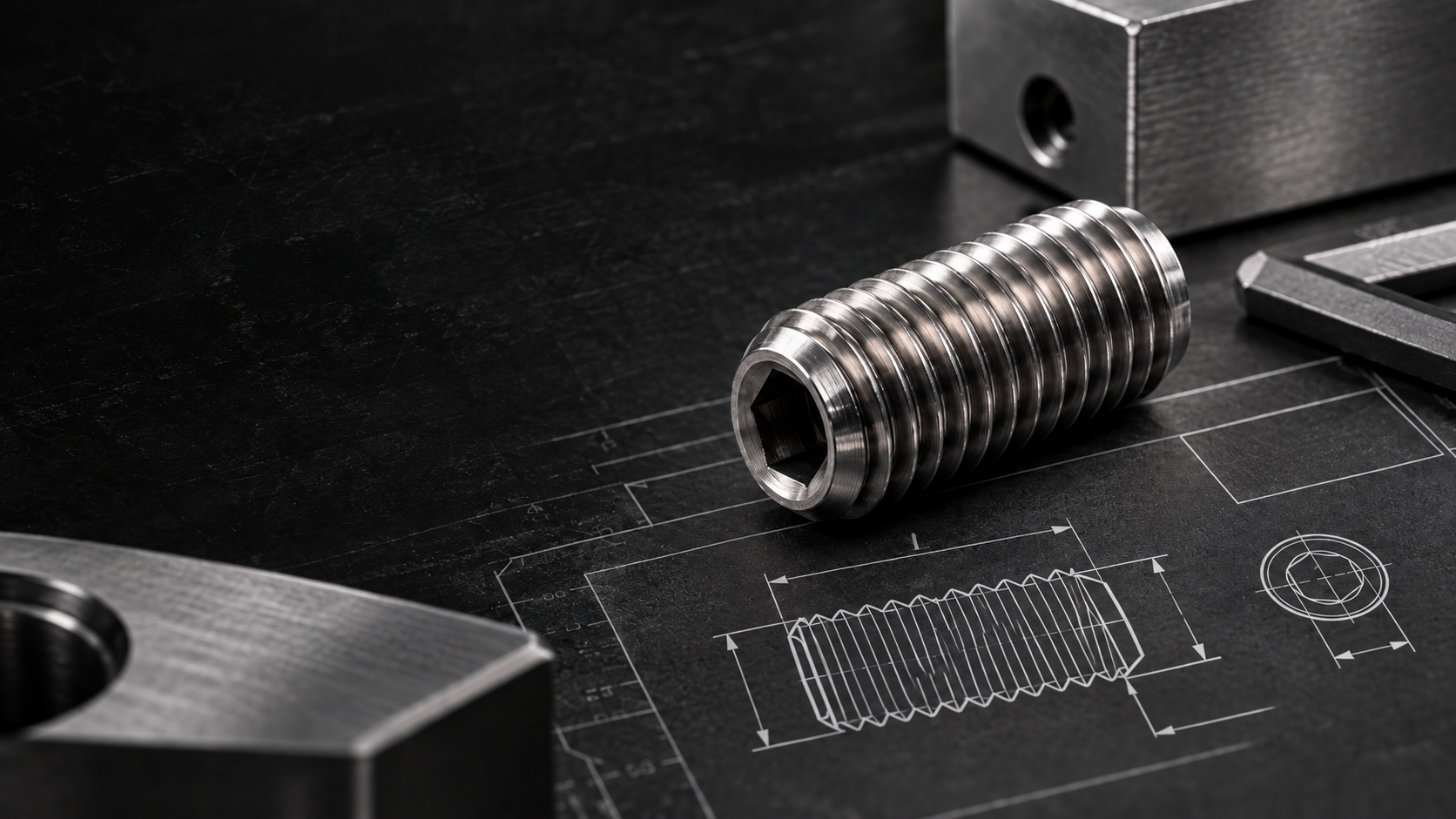
ISO 4026 / DIN 913
Flat Point Hex Socket Set Screw
Headless screw with hex socket drive and flat point, designed for compact fastening, component positioning and industrial assemblies where no element should protrude from the unit.
Compact fastening for clean mechanical assemblies
The ISO 4026 set screw, traditionally known as DIN 913, is a headless screw with Allen drive and flat point.
Its main function is to lock, fasten or position components inside a mechanical assembly, taking up minimum space and preventing the fastening element from protruding from the part.
Quick data
What is an ISO 4026 screw?
It is a headless set screw with metric thread and hex socket drive, used to fasten or position parts from inside the assembly.
Because it has no external head, it allows clean and compact assemblies. This is why it is used in machinery, shafts, bushings, pulleys, gears, tooling and positioning systems.
Headless
Allows the fastening to remain integrated in the part without protruding.
Hex socket
Tightened with an Allen key, even in areas with limited access.
Flat point
Supports the surface while reducing contact aggressiveness.
Compact assembly
Ideal when the available space inside the assembly is limited.
What is the flat point used for?
The flat point distributes pressure more gently than other, more aggressive ends such as cone point or cup point designs.
This geometry is useful when a part needs to be fastened while maintaining controlled contact with the surface, especially in assemblies where reducing marks or damage on the supported component is important.
Recommended use
- Fastening components onto shafts.
- Positioning bushings, pulleys or gears.
- Compact assemblies without an external head.
- Applications where surface marking should be reduced.
- Systems requiring internal adjustment or locking.
Main features of ISO 4026 / DIN 913
In a set screw, the point geometry defines how force is transmitted to the component and what type of contact is created.
| Feature | ISO 4026 / DIN 913 |
|---|---|
| Part type | Headless set screw |
| Drive | Hex socket Allen drive |
| Point | Flat point |
| Thread | ISO metric thread |
| Assembly | Internal, compact and without external protrusion |
| Typical use | Locking, positioning and fastening components |
| Traditional reference | DIN 913 |
ISO 4026 compared with ISO 4027, ISO 4028 and ISO 4029
All of them belong to the family of hex socket set screws, but each standard uses a different point geometry.
| Standard | Point | Typical use |
|---|---|---|
| ISO 4026 / DIN 913 | Flat point | Softer contact and compact fastening. |
| ISO 4027 / DIN 914 | Cone point | Localised locking with greater penetration. |
| ISO 4028 / DIN 915 | Dog point | Positioning in prepared seats or drilled locations. |
| ISO 4029 / DIN 916 | Cup point | Firm fastening on surfaces where marking is acceptable. |
Standardised hex socket set screws
The correct selection depends on the type of contact required between the screw and the part it works against.
Materials for custom ISO 4026 screws
Material selection must consider load, corrosion, temperature, wear, service environment and traceability requirements.
When a commercial part does not meet the project requirements, CNC machining allows set screws to be manufactured from drawings, using certified materials and adapted geometries.
Where ISO 4026 screws are used
They are used in assemblies where locking, adjustment or positioning is required while occupying minimum space.
Shafts
Bushings
Pulleys
Gears
Tooling
Machinery
Automation
Positioning
CNC manufacturing of custom set screws
Some applications require dimensions, materials, threads, lengths, treatments or tolerances that are not always available from catalogue stock.
At AREM-CNC, we manufacture components and threaded elements according to drawings, physical samples, DIN/ISO standards or customer specifications, reviewing every detail before production.
Customisable parameters
- Diameter and length.
- Thread type and pitch.
- Certified material.
- Point geometry.
- Hex socket depth.
- Tolerances and surface finish.
- Treatments according to application.
Technical documentation for critical parts
In industrial projects, material traceability and process control can be as important as the geometry of the part.
Frequently asked questions about ISO 4026 / DIN 913
What is an ISO 4026 screw?
It is a headless set screw with hex socket drive and flat point, used to lock or position components in compact assemblies.
Are ISO 4026 and DIN 913 equivalent?
DIN 913 is the traditional reference associated with this type of flat point set screw. In technical projects, the standard and edition indicated in the drawing should always be checked.
What is the difference between ISO 4026 and ISO 4027?
ISO 4026 uses a flat point, while ISO 4027 uses a cone point. The main difference is the way each screw contacts the part.
Can they be manufactured in Inconel or Superduplex?
Yes. CNC machining can be used to manufacture custom set screws in stainless steels, Duplex, Superduplex, Inconel, Hastelloy, Monel, titanium and other alloys, provided the design is feasible.
When should an ISO 4026 screw be manufactured from drawing?
When the standard part does not meet length, material, tolerance, finish, traceability or specific geometry requirements.
Do you need ISO 4026 set screws manufactured?
Send us your drawing, physical sample or technical specification. We will review material, dimensions, thread, tolerances, finish and documentation requirements to manufacture a reliable solution.