
17-4 PH
UNS S17400
Precipitation-hardening martensitic stainless steel used in CNC parts that require high mechanical strength, good hardness, dimensional stability and corrosion resistance.
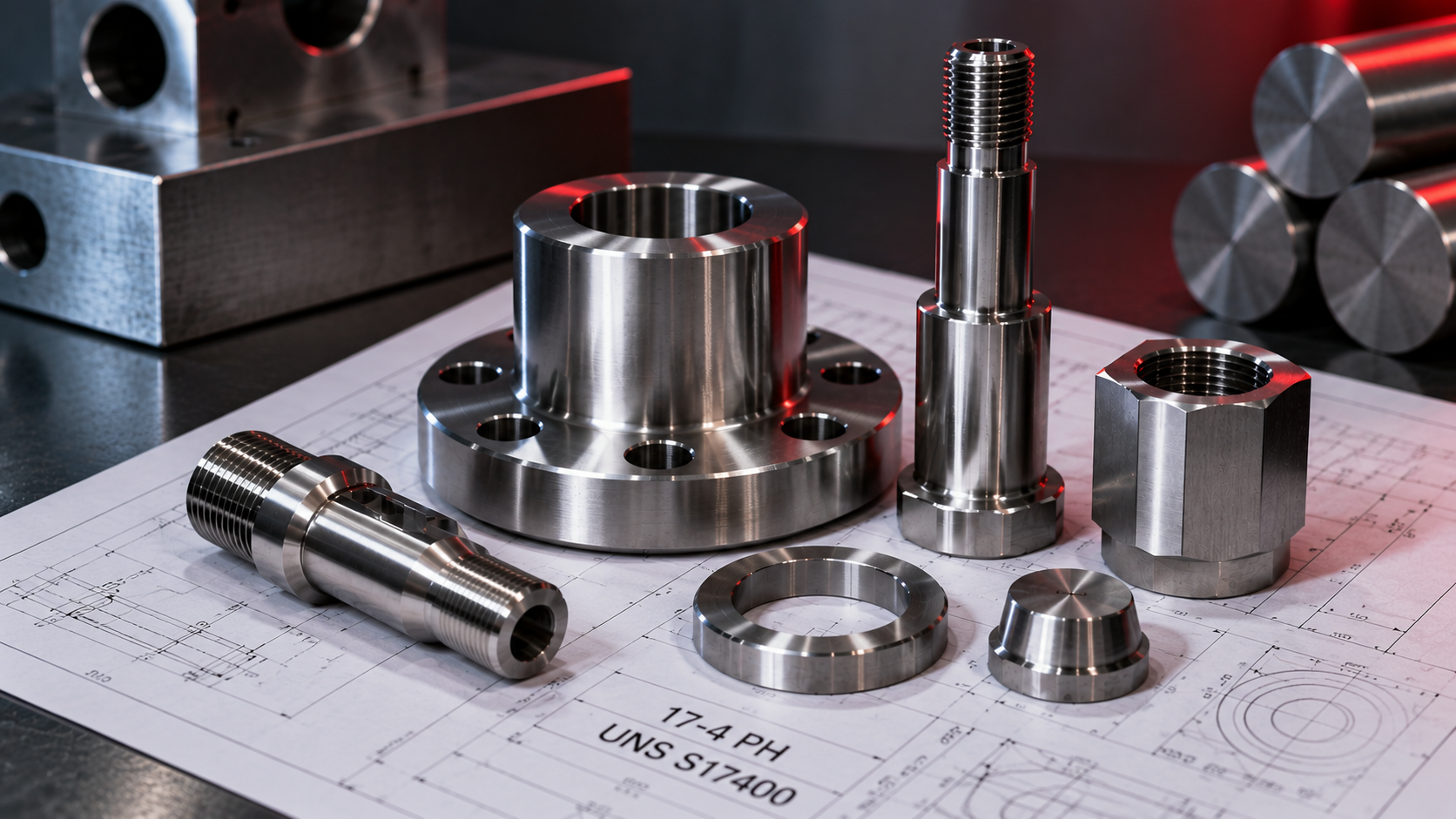
A versatile PH stainless steel for high strength
17-4 PH - UNS S17400 is one of the most widely used precipitation-hardening stainless steels in demanding industrial applications.
It combines high mechanical strength, good hardness, corrosion resistance and the possibility of adjusting its properties through heat treatment. This is why it is used in shafts, valves, fasteners, aerospace components, pumps, precision parts and made-to-drawing machined elements.
Material identification
What is 17-4 PH?
It is a precipitation-hardening martensitic stainless steel, also known as Type 630, AISI 630 or EN 1.4542.
Its composition based on chromium, nickel, copper and niobium/tantalum allows high mechanical properties to be achieved after an ageing treatment. This makes it a technical alternative when more strength is required than conventional austenitic stainless steels can provide.
High strength
Material suitable for parts subjected to load, pressure, fatigue or stress.
Good hardness
PH treatment allows high hardness and strength values to be achieved.
Corrosion
Offers corrosion resistance suitable for many technical applications.
Versatility
Widely used in CNC machining, fasteners, shafts, valves and critical components.
Why it is used in high-performance parts
17-4 PH is selected when the part requires strength, hardness, dimensional control and reliable service behaviour.
| Property | Technical advantage |
|---|---|
| High mechanical strength | Suitable for components subjected to stress, pressure, load or fatigue. |
| Precipitation hardening | Allows properties to be adjusted through conditions such as H900, H1025, H1075 or H1150. |
| Good hardness | Interesting for parts that require wear resistance and functional stability. |
| Corrosion resistance | Suitable behaviour for industrial, technical and mechanical environments. |
| Dimensional stability | Useful in machined parts with tight tolerances, threads and precise fits. |
| Wide industrial use | Applicable in aerospace, petrochemical, valves, pumps, shafts and fasteners. |
A classic chemistry for PH stainless steel
17-4 PH combines chromium, nickel, copper and niobium/tantalum to achieve a precipitation-hardening martensitic structure.
Chromium provides corrosion resistance, nickel contributes to material stability, copper participates in hardening and niobium/tantalum helps control the metallurgical response during heat treatment.
Typical chemical composition
H conditions to adjust strength and toughness
17-4 PH is usually supplied in solution-treated condition and then aged to reach the mechanical condition required by the drawing, standard or application.
Maximum strength
Condition aimed at obtaining high strength and hardness values.
Technical balance
Compromise between strength, ductility and stability for demanding parts.
More toughness
Intermediate condition when more balanced behaviour is required.
More ductility
Option aimed at higher ductility, toughness and service behaviour.
Where 17-4 PH is used
This material is used in sectors where parts require strength, reliability, traceability and dimensional control.
Aerospace
Petrochemical
Valves
Pumps
Fasteners
Technical shafts
Chemical equipment
Nuclear components
CNC machining of 17-4 PH
Machining 17-4 PH requires control of hardness, temperature, surface finish, deformation and dimensional stability.
At AREM-CNC, we manufacture parts in special stainless steels from drawings, physical samples or technical specifications, adapting the process to the material condition, heat treatment, geometry, tolerances and required documentation.
Made-to-drawing production
- Special screws and studs.
- Nuts, washers and technical bushings.
- Shafts, pins and precision components.
- Parts for valves, pumps and pressure equipment.
- Industrial and aerospace fasteners.
- One-off, short-run or medium-run production according to specification.
Controlled production for critical components
CNC manufacturing transforms 17-4 PH into precise, repeatable and traceable components for projects where strength, geometry and technical documentation are decisive.
Precise geometry
Manufacturing adapted to drawing, sample or technical specification.
High strength
Material suitable for components with high mechanical requirements.
Dimensional control
Verification of dimensions, tolerances, threads and functional requirements.
PH treatment
Possibility to work according to the required H condition or state.
Technical finish
Surfaces adapted to assembly, fit, sealing or mechanical function.
Traceability
Documentation associated with material, batch, process and final control.
Technical documentation for PH steels
In precipitation-hardening materials, traceability allows control of composition, batch, supply condition, heat treatment and final part requirements.
Depending on the project, we can work with material certificates, heat numbers, treatment condition, dimensional control, technical drawings and final documentation associated with manufacturing.
Frequently asked questions about 17-4 PH
What is 17-4 PH stainless steel?
It is a precipitation-hardening martensitic stainless steel, identified as UNS S17400 and Type 630, used for high-strength parts, good hardness and corrosion resistance.
What does PH mean?
PH means precipitation hardening. Its mechanical properties are adjusted through ageing heat treatments.
Which standards are associated with 17-4 PH?
Common references include UNS S17400, Type 630, ASTM A564, AMS 5643, AISI 630 and EN 1.4542.
Can made-to-drawing CNC parts be manufactured in 17-4 PH?
Yes. CNC machining can be used to manufacture screws, nuts, washers, shafts, pins, bushings, fasteners and special made-to-drawing components, provided that the geometry is feasible.
Why is it important to specify the H condition?
Because the strength, hardness, ductility and final behaviour of 17-4 PH depend on the material condition and the specified ageing treatment.
Do you need parts manufactured in 17-4 PH?
Send us your drawing, physical sample or technical specification. We will review material, supply condition, treatment, tolerances, geometry and required documentation to manufacture a reliable solution.