
ISO 4017
DIN 933
Fully threaded hexagon head screw designed for strong mechanical joints, industrial assemblies, metal structures, machinery and made-to-drawing component manufacturing.
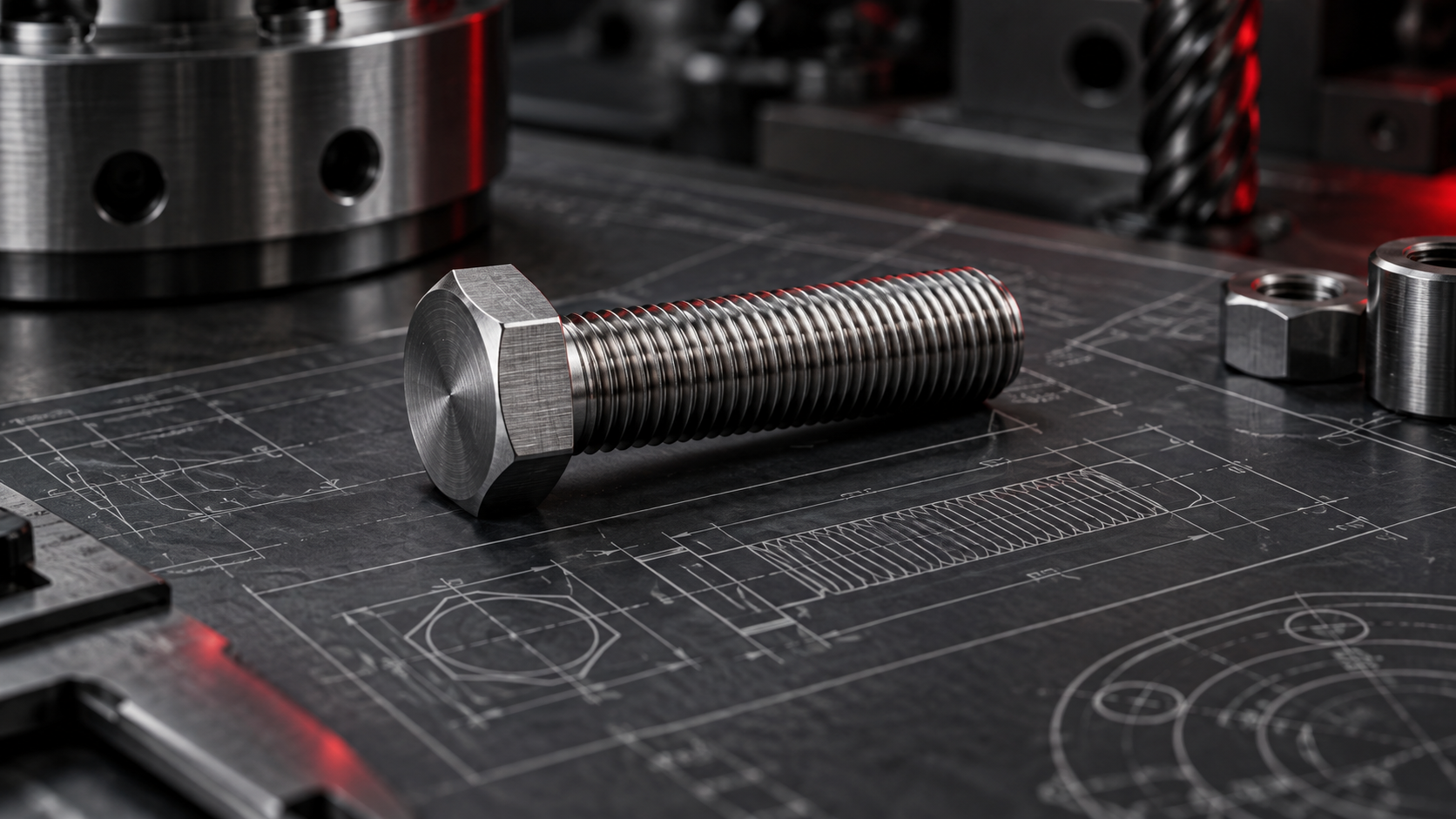
A fully threaded hexagon screw for industrial fastening
ISO 4017, also known as DIN 933, is a hexagon head screw with a full ISO metric thread along the shank.
It is used in joints where uniform fastening is required, especially in threaded holes, thinner materials, assemblies without a nut or applications where full thread length provides greater assembly flexibility.
Screw identification
What is an ISO 4017 screw?
It is a fully threaded hexagon head screw designed for mechanical fastenings where the joint needs to use the entire threaded length of the screw.
Unlike partially threaded screws, ISO 4017 can work directly in threaded holes, reduced thicknesses or assemblies where no nut is used. This makes it a very common part in industry, maintenance, machining and metal construction.
Full thread
The thread runs along the shank and makes assembly in threaded holes easier.
Hexagon head
Compatible with spanners, sockets and standard hexagonal tools.
International standard
Manufactured according to ISO 4017, commonly used as the technical equivalent of DIN 933.
Industrial use
Widely used in machinery, structures, maintenance and CNC components.
A simple geometry with strong industrial value
The strength of ISO 4017 lies in its combination of hexagon head, full thread and wide availability in materials, grades and sizes.
| Element | Technical description |
|---|---|
| Standard | ISO 4017 / DIN 933. |
| Head type | Hexagon head for external tightening. |
| Thread | Full-length ISO metric thread. |
| Thread direction | Usually right-hand thread. |
| Tool | Compatible with standard spanners and hex sockets. |
| Main use | Mechanical fastenings, industrial assemblies and threaded-hole joints. |
Common ISO 4017 screw dimensions
ISO 4017 is manufactured in multiple standard diameters and lengths. The following table summarises common sizes used in industrial fasteners and mechanical assembly.
| Thread | Pitch | Head width s | Head height k | Common use |
|---|---|---|---|---|
| M4 | 0.7 mm | 7 mm | 2.8 mm | Light assemblies and small parts. |
| M5 | 0.8 mm | 8 mm | 3.5 mm | Compact mechanical components. |
| M6 | 1.0 mm | 10 mm | 4.0 mm | General industrial assembly. |
| M8 | 1.25 mm | 13 mm | 5.3 mm | Machinery, supports and structures. |
| M10 | 1.5 mm | 17 mm | 6.4 mm | Higher-load mechanical joints. |
| M12 | 1.75 mm | 19 mm | 7.5 mm | Structures and industrial assemblies. |
| M16 | 2.0 mm | 24 mm | 10 mm | High-demand fastenings. |
| M20 | 2.5 mm | 30 mm | 12.5 mm | Heavy machinery and structures. |
Metric diameter
Defines the nominal thread diameter of the screw.
Spanner width
Distance across flats of the hexagon head.
Head height
Total height of the hexagon screw head.
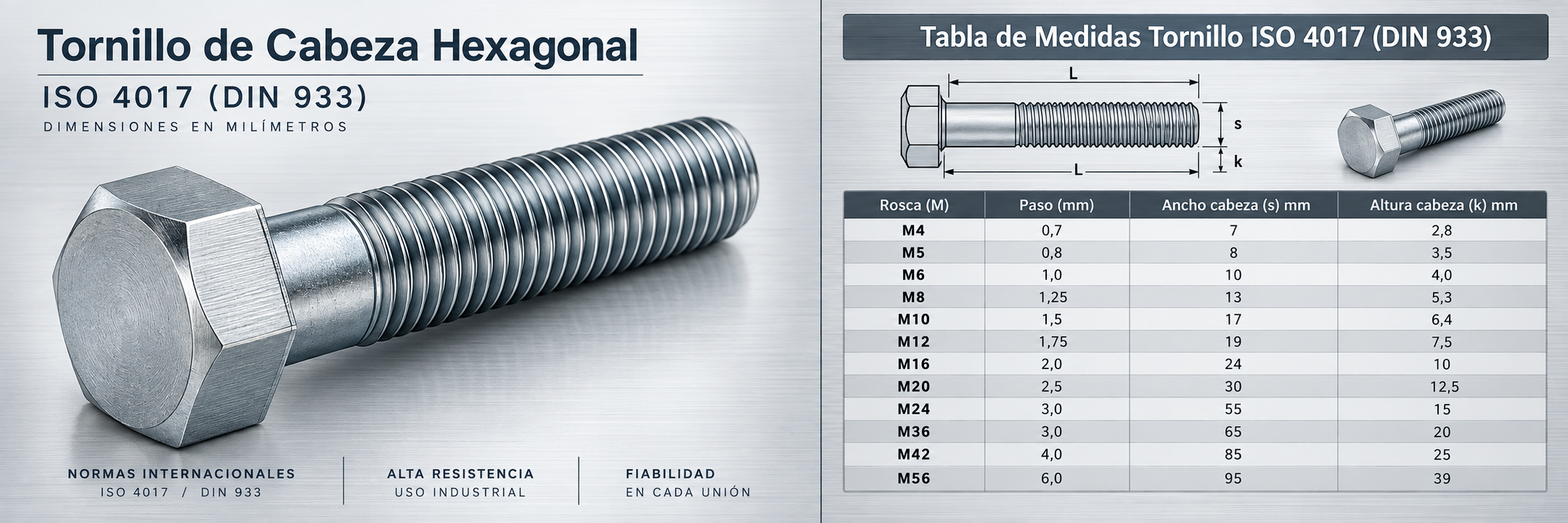
ISO 4017 / DIN 933 hexagon head screw
Technical image with a view of the fully threaded hexagon head screw, dimensional diagram and main measurement table for quick reference.
The material defines strength, corrosion resistance and final use
ISO 4017 / DIN 933 screws can be supplied or manufactured in different grades depending on load, environment, assembly and technical requirements.
For correct selection, mechanical strength, corrosion, temperature, compatibility with the part, surface treatment and required documentation should be considered.
Industrial steel
Common grade for general use in machinery and industrial assemblies.
High strength
For joints with higher loads or greater mechanical requirements.
High stress
Demanding applications where maximum strength is required.
Stainless steel 304
Suitable for indoor environments, humidity and moderate corrosion.
Stainless steel 316
Suitable for marine or corrosive environments.
On request
Brass, titanium, special steels or technical materials according to drawing.
Where ISO 4017 / DIN 933 is used
It is a highly versatile fastening for sectors that require quick assembly, standardised availability and a reliable mechanical joint.
CNC machining
Industrial machinery
Metal structures
Industrial assemblies
Metal fabrication
Maintenance
Automotive
Mechanical engineering
Difference between ISO 4017 and ISO 4014
The key difference is thread length. ISO 4017 has a full thread; ISO 4014 uses a partial thread and is used when a plain shank section is required.
Full thread
Recommended for thin sections, threaded holes or assemblies without a nut.
Common equivalence
Widely used designation for fully threaded hexagon head screws.
Partial thread
Useful when a plain bearing section or improved shear behaviour is required.
ISO 4017 screws and special made-to-drawing parts
At AREM-CNC, we can work with standard fasteners, special parts and industrial components manufactured from drawings, physical samples or technical specifications.
We review material, thread, tolerances, geometry, finish, surface treatment and documentation to adapt each solution to the real needs of the project.
Related capabilities
- Special hexagon head screws.
- Threaded made-to-drawing parts.
- CNC machined components.
- Manufacturing in steel, stainless steel and special alloys.
- Finishes and treatments according to specification.
- Dimensional control and technical documentation.
Technical control in fasteners and standardised components
In industrial fasteners, material traceability, standard, mechanical grade and dimensions are essential to ensure safe assembly.
Depending on the project, we can work with material certificates, heat numbers, mechanical class, drawings, tolerances, dimensional control and final documentation.
Frequently asked questions about ISO 4017 / DIN 933
What is an ISO 4017 screw?
It is a fully threaded metric hexagon head screw used in mechanical fastenings, industrial assembly, maintenance and structures.
Is ISO 4017 the same as DIN 933?
DIN 933 is a widely used designation for the fully threaded hexagon head screw. ISO 4017 is the international reference currently used in many drawings and technical orders.
What is the difference between ISO 4017 and ISO 4014?
ISO 4017 has a full thread, while ISO 4014 has a partial thread. ISO 4017 is more suitable for threaded holes and reduced thicknesses.
Which materials are commonly used?
The most common materials are carbon steels 8.8, 10.9 and 12.9, A2/A4 stainless steel, and on request other materials such as brass, titanium or special steels.
Can AREM-CNC manufacture special screws or made-to-drawing parts?
Yes. We can study manufacturing from drawings, samples or technical specifications, reviewing material, thread, tolerances, geometry and documentation.
Do you need ISO 4017, DIN 933 or special threaded parts?
Send us your drawing, physical sample or technical specification. We will review material, thread, geometry, tolerances, finish and documentation to manufacture a precise, reliable and traceable solution.