
ISO 4014 Bolt DIN 931
A standardized partial-thread hexagon head bolt designed for high-strength mechanical joints, steel structures, industrial machinery and applications where improved shear performance is required.
A standardized bolt for demanding structural joints
ISO 4014, also known as DIN 931, is used when the joint requires strength, precise alignment and correct load distribution.
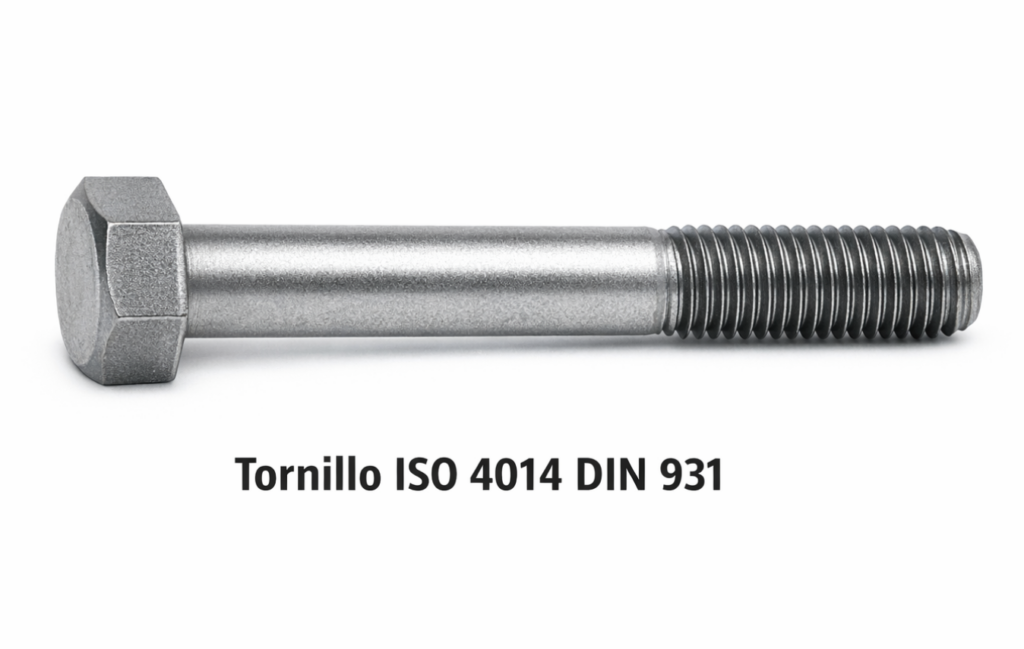
The ISO 4014 hexagon head bolt is a fastening element with a hexagonal head and partial thread. Its design combines a smooth shank section with a threaded section for tightening, improving performance in joints subjected to structural loads.
It is one of the most widely used bolts in machining, metal fabrication, steel structures, industrial machinery and maintenance. Its standardization ensures compatibility with standard nuts and washers.
Unlike ISO 4017 or DIN 933, ISO 4014 is not fully threaded along its entire length. This difference makes it especially useful in critical applications where the bolt works under shear load.
Designed for assembly, strength and compatibility
Standard hexagonal head
Enables tightening with common tools and allows controlled torque application.
Partial thread
Its smooth shank helps improve joint performance when working under shear load.
High mechanical strength
Available in strength classes for general use, high-load assemblies and extreme applications.
International standard
Identified under ISO 4014, DIN 931 and EN 24014 to ensure industrial compatibility.
Stainless steel options
A2 and A4 versions for standard, marine or chemically exposed environments.
Compatible with nuts and washers
Can be combined with ISO 4032 nuts and ISO 7089 or ISO 7090 flat washers.
Options for industrial use, high loads and corrosion resistance
Carbon steel
Classes 8.8, 10.9 and 12.9 allow the bolt to be adapted to general-use applications, high-load assemblies or extreme stresses in machinery and structures.
General industrial use, steel structures and common mechanical assemblies.
High-load applications where greater mechanical strength is required.
Machinery, extreme stresses and highly demanding critical joints.
Good corrosion resistance in standard environments.
Recommended for marine, humid or chemically exposed environments.
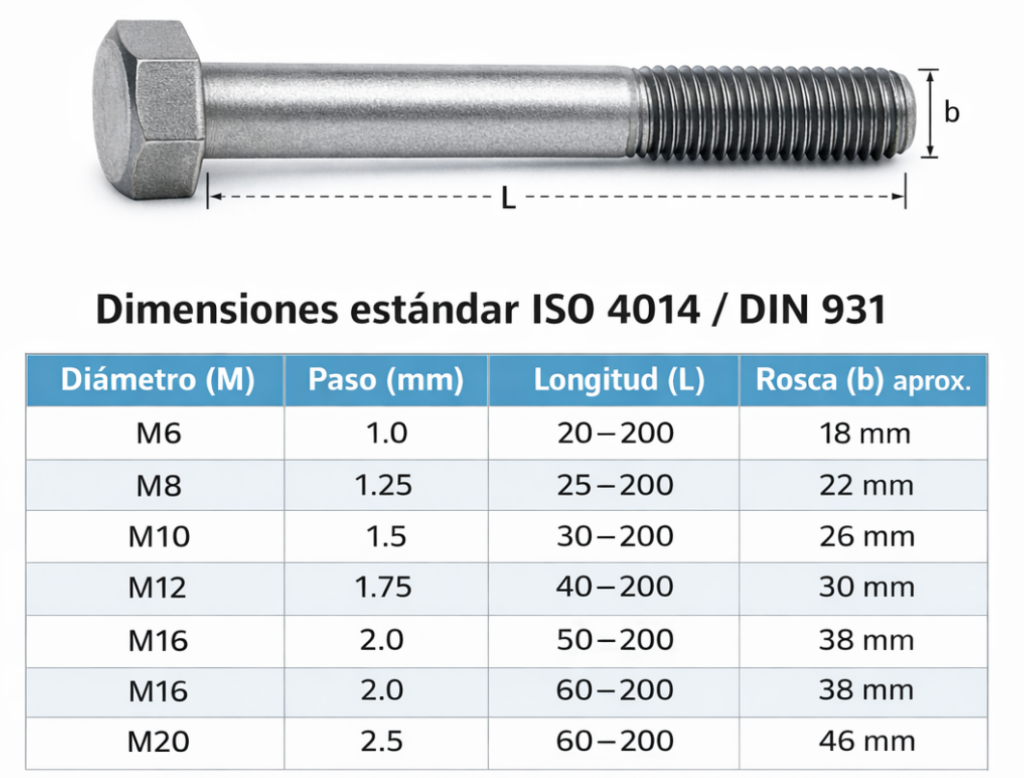
ISO 4014 / DIN 931 reference summary
Reference table for common metric diameters. For exact measurements and tolerances, always consult the ISO 4014 standard.
| Diameter | Pitch | Length | Approx. thread |
|---|---|---|---|
| M6 | 1.0 mm | 20–200 mm | 18 mm |
| M8 | 1.25 mm | 25–200 mm | 22 mm |
| M10 | 1.5 mm | 30–200 mm | 26 mm |
| M12 | 1.75 mm | 40–200 mm | 30 mm |
| M16 | 2.0 mm | 50–200 mm | 38 mm |
| M20 | 2.5 mm | 60–200 mm | 46 mm |
Fasteners for machinery, structures and mechanical assemblies
The ISO 4014 bolt is especially useful when the joint works under significant mechanical stress and a robust, standardized fastening solution is required.
Difference between ISO 4014 and ISO 4017
| Standard | Thread type | Recommended use |
|---|---|---|
| ISO 4014 / DIN 931 | Partial thread | Structural use, high loads and shear stress |
| ISO 4017 / DIN 933 | Full thread | General assemblies and fastenings with full adjustment |
Correct assembly for reliable joints
To obtain a stable joint, it is important to select the right nut, washer, strength class and tightening torque according to the application.
Ensures dimensional compatibility and suitable strength in the assembly.
Improves load distribution and protects the bearing surface.
It should be defined according to class, diameter, lubrication and application.
Helps prevent galling during assembly and disassembly.
Especially in critical joints, machinery or structures subjected to load.
Do you need ISO fasteners or standardized parts?
At AREM-CNC, we work with standardized parts, CNC machining and industrial solutions for projects where precision, strength and repeatability are essential.