
ISO 10642
Socket countersunk screw
Countersunk head screw with hexagon socket, designed to sit flush with the surface of the part when protrusions, interference or loss of precision in the assembly are not acceptable.
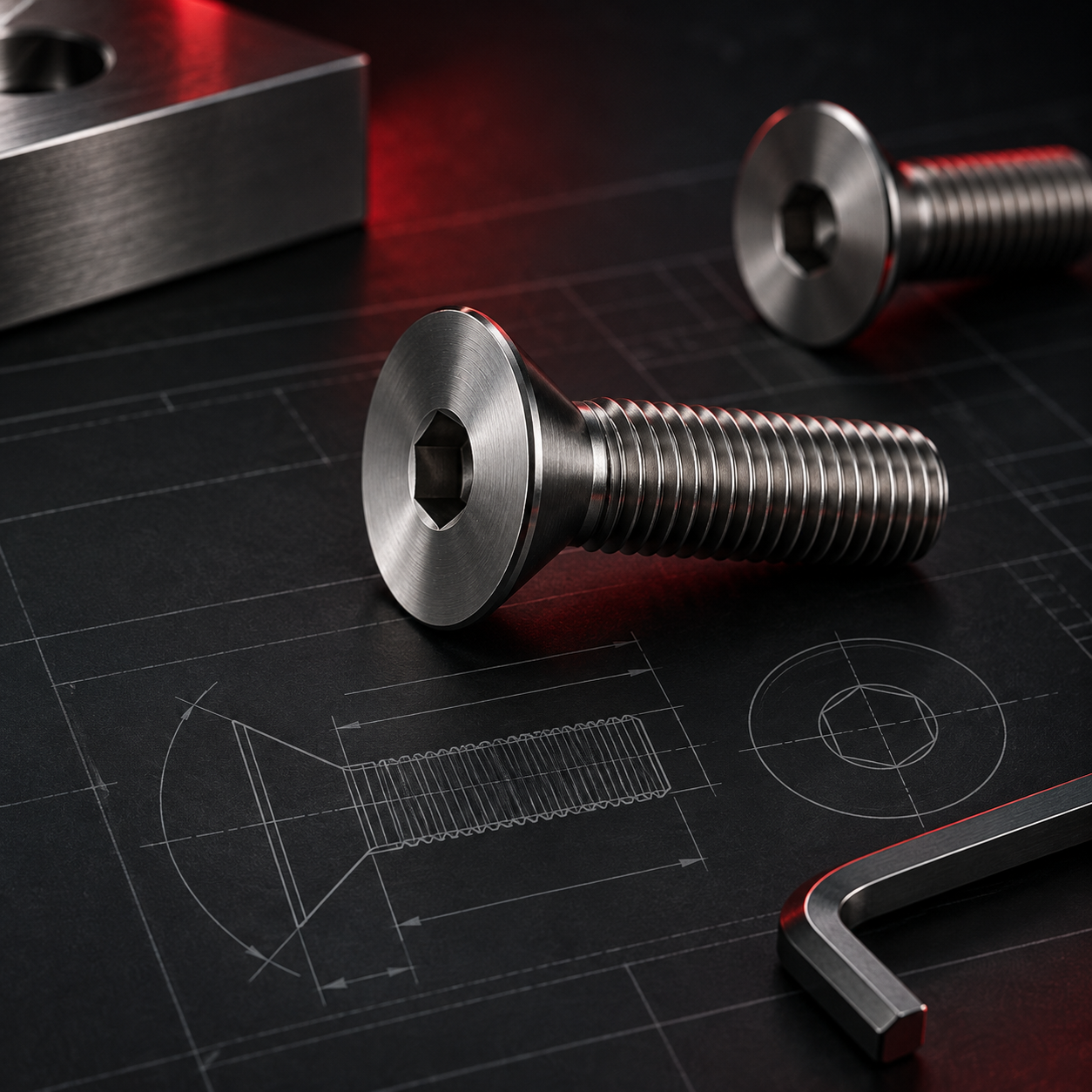
A flush fastening solution for precise mechanical design
ISO 10642 is a socket countersunk screw with hexagon socket drive and ISO metric thread, designed to integrate into the part through a 90° countersunk seat.
It is used when the screw head cannot protrude: precision machined parts, tooling, moulds, plates, guides, moving assemblies and machinery where any interference can affect the performance of the whole system.
Screw identification
What is an ISO 10642 screw?
It is a countersunk head screw with hexagon socket drive, designed to sit completely flush with the surface after assembly.
The conical head sits inside a machined countersink in the part. This creates a clean surface, with no protrusions and with a reliable fastening for technical applications where space, appearance or mechanical interference are critical.
Flush head
The head is integrated into the part and avoids interference.
90° countersink
Requires a machined conical seat for correct support.
Internal Allen drive
The hexagon socket drive allows compact assembly.
Technical design
Widely used in machining, moulds, guides, tooling and machinery.
Why this screw is not only an aesthetic choice
The main function of ISO 10642 is to provide a strong fastening without the head protruding from the part. In mechanical design, choosing this screw usually responds to a functional requirement.
| Element | Technical description |
|---|---|
| Standard | ISO 10642, the international replacement for the former DIN 7991. |
| Head type | Countersunk head with 90° conical seat. |
| Drive | Hexagon socket Allen drive for assembly with an Allen key or hex bit. |
| Thread | ISO metric thread, usually fully threaded depending on size and supply. |
| Assembly | Requires a previous countersink in the part so that the head sits flush. |
| Function | Avoids protrusions, interference, friction and movement problems. |
The right grade according to load, environment and assembly
ISO 10642 screws can be manufactured in different materials and mechanical classes depending on the final application.
In precision machining, the screw standard is not the only important factor: material grade, surface treatment, tightening torque and countersink precision also matter.
Industrial steel
General use in machinery and mechanical assemblies.
High strength
For joints with greater mechanical requirements.
Maximum strength
Very common in precision machining and tooling.
Stainless steel
For humidity, corrosion or more demanding environments.
Protection
Surface treatment to improve environmental resistance.
On request
Materials or technical coatings according to drawing or application.
ISO 10642 dimensional summary
Reference table with common thread sizes, pitch, head diameter, head height and Allen key size. For manufacturing or technical purchasing, the project standard and drawing should always be checked.
| Thread | Pitch | Head diameter dk | Head height k | Allen key |
|---|---|---|---|---|
| M3 | 0.5 | 6.0 mm | 1.7 mm | 2 mm |
| M4 | 0.7 | 8.0 mm | 2.3 mm | 2.5 mm |
| M5 | 0.8 | 10.0 mm | 2.8 mm | 3 mm |
| M6 | 1.0 | 12.0 mm | 3.3 mm | 4 mm |
| M8 | 1.25 | 16.0 mm | 4.4 mm | 5 mm |
| M10 | 1.5 | 20.0 mm | 5.5 mm | 6 mm |
| M12 | 1.75 | 24.0 mm | 6.5 mm | 8 mm |
Seat angle
The countersink must respect the correct angle to avoid defective support.
Head diameter
Defines the outside diameter of the countersunk head.
Head height
Determines the countersink depth and the final seating position.
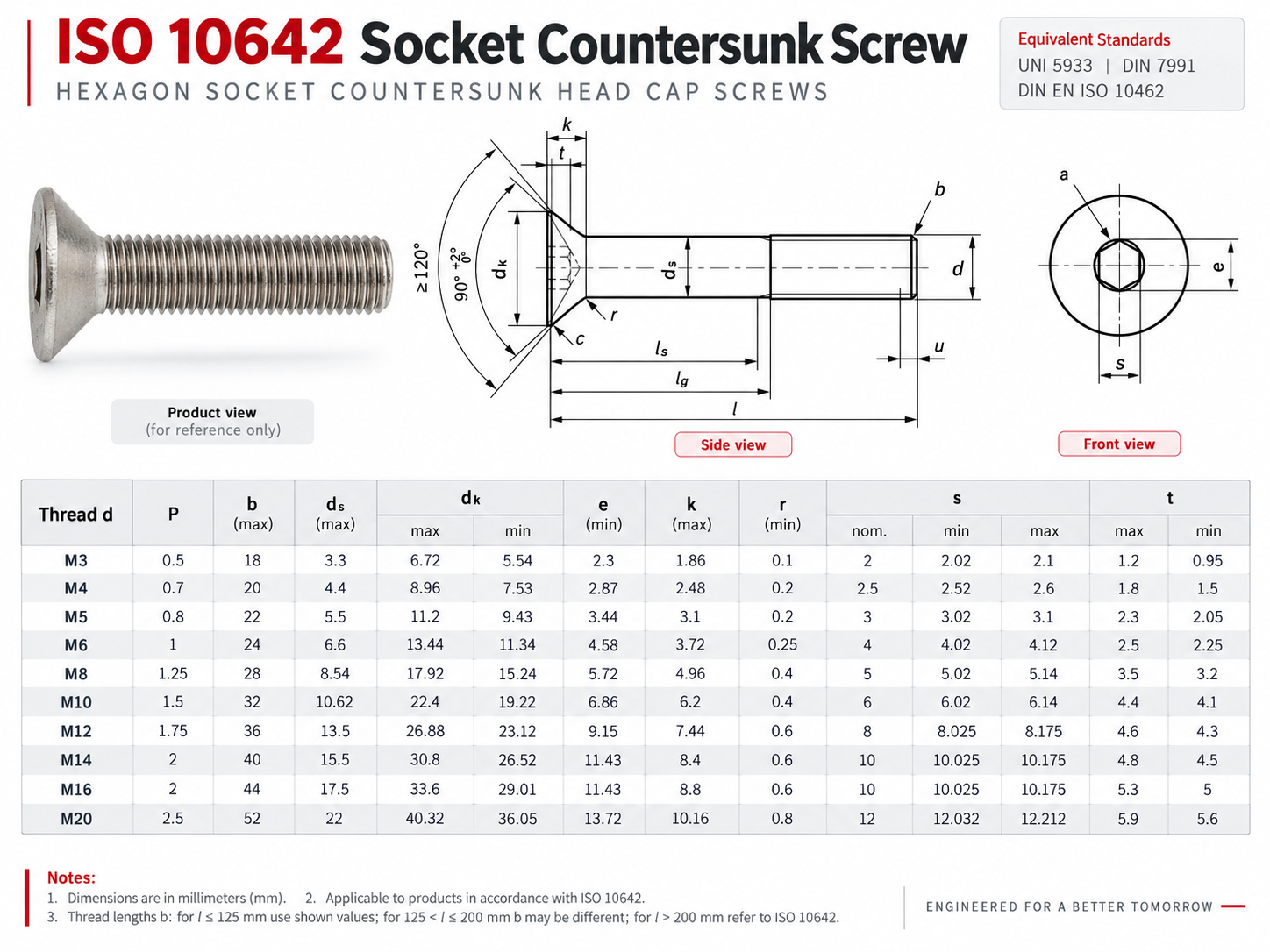
Screw view, drawing and dimensional table
Visual references for the ISO 10642 screw, its countersunk head geometry, the technical drawing and the main dimensions for quick reference.
Where ISO 10642 is used
This screw is used when the final surface must remain clean, without a protruding head and without interference with movement, assembly or design.
Machined parts
Tooling
Moulds and dies
Technical plates
Linear guides
Moving assemblies
Machinery
Industrial fasteners
ISO 10642 compared with other Allen screws
The choice between Allen screws does not depend only on appearance. The head geometry changes the assembly behaviour and the function of the joint.
Countersunk head
Sits flush with the surface. Recommended when the head cannot protrude.
Cylindrical head
Protrudes from the surface. Suitable when support and strength are prioritised.
Button head
Protrudes slightly. A low-profile alternative with a smoother finish.
The countersink determines whether the screw works properly
A poorly installed ISO 10642 screw loses its main advantage: sitting flush without generating stress, play or deformation.
The countersinking tool, angle, tightening torque and head seating must be carefully controlled, especially in precision parts, high-strength steels and loaded joints.
Key points
- Machine the countersink with the correct tool.
- Respect the 90° angle.
- Do not force the head seat.
- Apply the correct tightening torque according to class and material.
- Avoid unnecessary retightening in high-strength grades.
- Check that the head is truly flush with the surface.
ISO 10642 and made-to-drawing manufacturing
At AREM-CNC, we manufacture and machine technical parts where fasteners, countersunk seats and the geometry of the assembly must work as one complete solution.
We can work from drawings, physical samples or technical specifications, reviewing material, thread, countersink, tolerances, finish, assembly and required documentation for each application.
Frequently asked questions about ISO 10642
What is an ISO 10642 screw?
It is a socket countersunk screw designed to sit flush with the surface through a conical seat machined into the part.
Does ISO 10642 replace DIN 7991?
Yes. ISO 10642 is the international standard that replaces the former DIN 7991 for socket countersunk screws.
When is a countersunk screw used?
It is used when no head can protrude, when there is friction or movement, or when the design requires clean surfaces without interference.
What angle should the countersink have?
The seat must respect the 90° angle so that the head supports correctly and sits flush.
Which materials are commonly used?
The most common options are carbon steel in classes 8.8, 10.9 and 12.9, A2/A4 stainless steel and versions with surface treatments such as zinc plating, black oxide or technical coatings on request.
Do you need ISO 10642 screws or parts with countersunk seats?
Send us your drawing, physical sample or technical specification. We will review material, thread, geometry, countersink, tolerances and finish to manufacture a precise, functional and reliable solution.