
Hexagon Bolt ISO 4017 DIN 933
Full thread hexagon bolt for industrial assemblies, steel structures, machinery and applications where uniform fastening is required along the full usable length of the bolt.
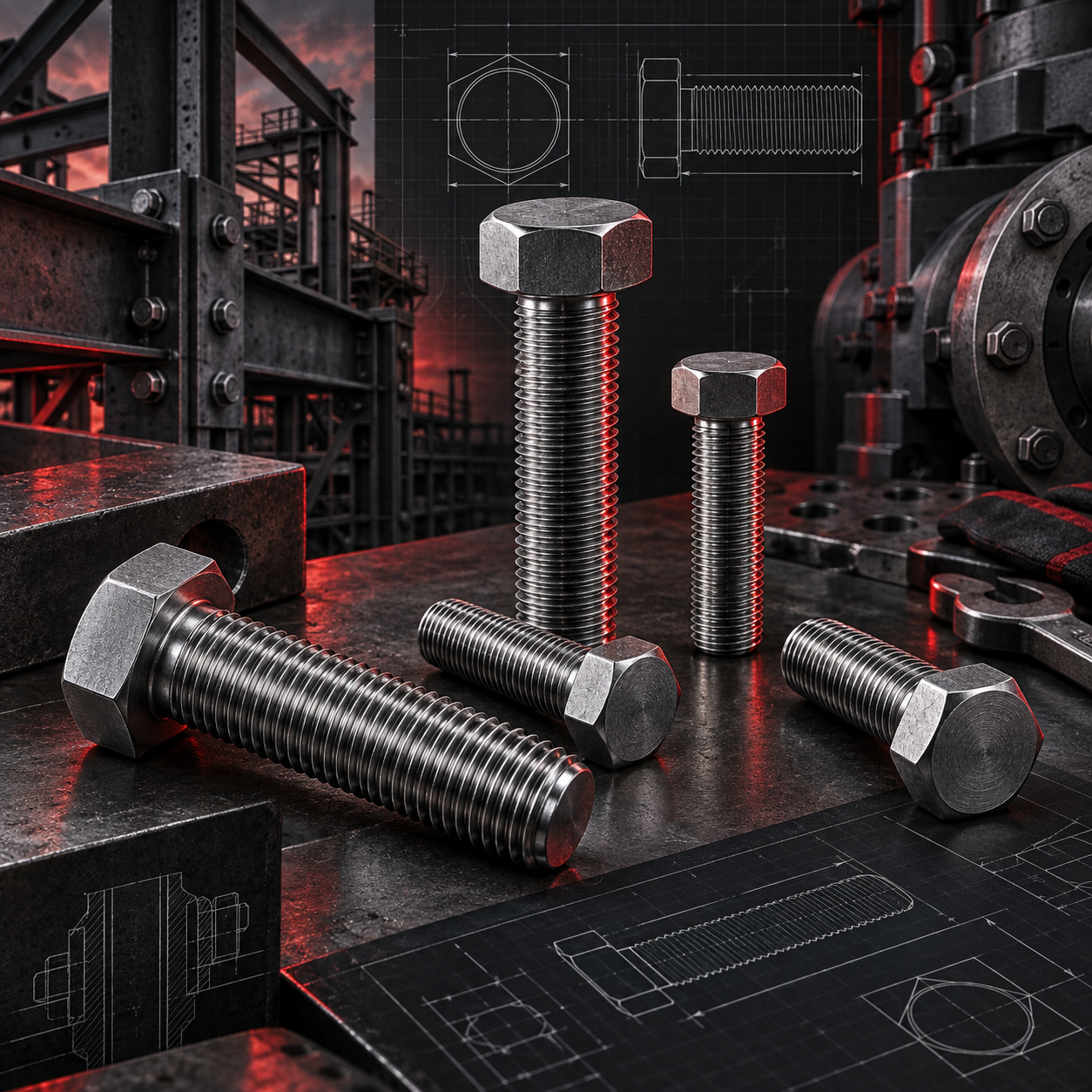
An essential standard in industrial fastening
The ISO 4017 screw, equivalent to DIN 933, is a hexagon head bolt with full metric thread. Its design allows it to work with ISO nuts, standardized washers or direct threading into machined parts.
Unlike ISO 4014, ISO 4017 does not include a smooth shank section. The thread reaches up to the head, making it a suitable solution when maximum grip surface and adjustment across variable thicknesses are required.
Full thread
Provides useful fastening along the full length of the bolt.
Hexagon head
Compatible with open-end wrenches, combination spanners, sockets and standard tools.
Industrial use
Common in machinery, maintenance, structures and mechanical assemblies.
Standardized solution
Improves compatibility, traceability and supply availability.
Main technical characteristics
Key parameters for correctly identifying the ISO 4017 / DIN 933 bolt in machining, maintenance and industrial assembly environments.
Materials, grades and finishes
Common materials
- Carbon steel · grades 8.8, 10.9 and 12.9
- Stainless steel · A2 and A4 grades
- Special steels · according to technical requirements
Surface treatments
- Zinc plated · general protection against oxidation
- Galvanized · higher environmental resistance
- Black oxide · industrial technical finish
- Technical coatings · according to project requirements
Material selection should be based on load, corrosion, temperature, working environment and applicable standards.
Difference between ISO 4017 and ISO 4014
The choice between both standards depends on the joint type, part thickness, stress distribution and expected mechanical behavior.
Full thread
- Thread up to the head
- Greater gripping surface
- Useful for variable thicknesses
- General assemblies and maintenance
Partial thread
- Includes a smooth shank section
- Better shear behavior
- Suitable for structural joints
- Greater support in non-threaded areas
Summary dimensions table
| Thread d | Pitch P | Spanner size s | Head height k |
|---|---|---|---|
| M4 | 0.7 | 7 mm | 2.8 mm |
| M5 | 0.8 | 8 mm | 3.5 mm |
| M6 | 1.0 | 10 mm | 4.0 mm |
| M8 | 1.25 | 13 mm | 5.3 mm |
| M10 | 1.5 | 17 mm | 6.4 mm |
| M12 | 1.75 | 19 mm | 7.5 mm |
| M16 | 2.0 | 24 mm | 10.0 mm |
| M20 | 2.5 | 30 mm | 12.5 mm |
- Full thread along the entire usable length.
- Coarse pitch as standard, fine pitch available on request.
- Standard ISO tolerance according to manufacturing specification.
- Compatible with ISO 4032 nuts and ISO washers.
Common industrial applications
A standard part, but critical in industry
ISO 4017 / DIN 933 may look like a basic screw, but it is essential for ensuring safe, repeatable joints compatible with international standards. Choosing the correct standard, material and mechanical grade is key to ensuring performance and reliability.
Standardized fasteners integrated into machining processes
At AREM-CNC, we work with standardized components and machined parts according to drawing, with dimensional control, certified materials and technical documentation support.