
ISO 4762 vs DIN 912 Differences and equivalence
Technical comparison between ISO 4762 and DIN 912, two designations used to identify socket head cap screws used in machinery, fixtures, machined parts and precision industrial assemblies.
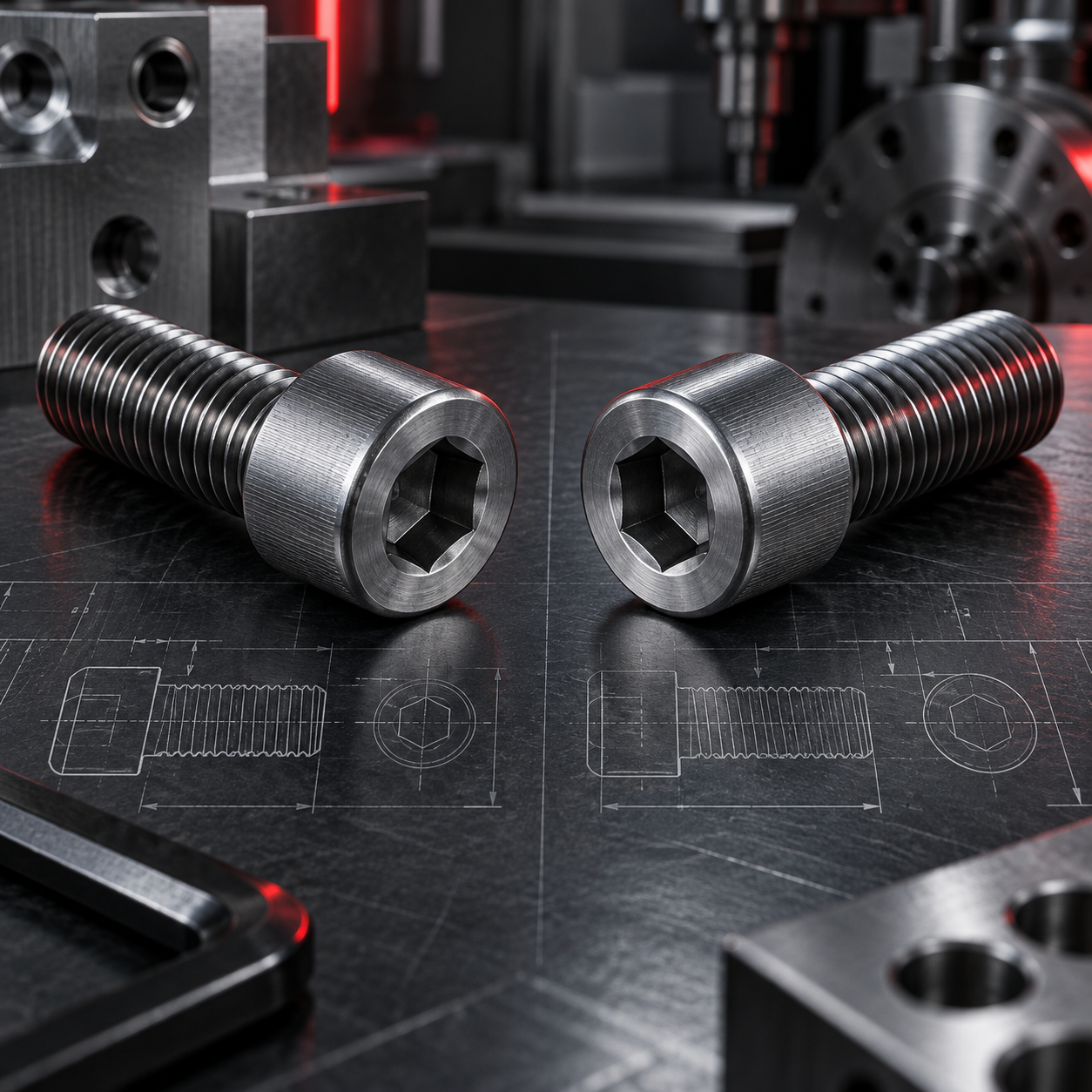
Two names for the same family of socket screws
In technical purchasing, industrial catalogues and manufacturing documentation, it is common to find references to ISO 4762 and DIN 912 for socket head cap screws. Both designations are used to identify a fastener with internal hex drive, cylindrical head and metric thread.
The key is understanding which standard appears on the drawing, what the customer requires and which dimensions, tolerances, strength class, material and finish must be respected during supply or manufacturing.
ISO 4762
International standard used for cylindrical head screws with internal hex drive.
DIN 912
Classic DIN designation still widely used in drawings, warehouses and technical catalogues.
Practical equivalence
In many projects they are treated as equivalent references, always verifying the specification.
Technical control
Selection must confirm dimensions, material, strength class and surface finish.
Common characteristics of the socket head cap screw
Both ISO 4762 and DIN 912 are associated with cylindrical head screws with internal hex drive, designed for assemblies where precise tightening torque and work in reduced spaces are required.
ISO 4762 vs DIN 912: direct comparison
The main difference is not so much the visual shape of the screw, but the standard designation used, the reference edition and the technical documentation of the project.
International reference
- Commonly used in current technical documentation.
- Identifies cylindrical head socket screws.
- Used in global specifications.
- Requires confirmation of metric size, length and class.
Traditional designation
- Very common in older drawings and European catalogues.
- Still used in warehouses and technical purchasing.
- Refers to the same type of cylindrical socket screw.
- Should be verified against the requested equivalence.
What the technical department should review
Standardized dimensions
Check thread diameter, pitch, length, head diameter, head height and Allen key size.
Strength class
Verify whether the project requires class 8.8, 10.9, 12.9 or another mechanical specification.
Material and finish
Confirm carbon steel, stainless steel, special alloy, black oxide, zinc plating, technical coating or specific treatment.
Applicable drawing or standard
Check whether the customer requires manufacturing according to ISO, DIN, their own drawing or a specific documented equivalence.
Comparison summary table
| Aspect | ISO 4762 | DIN 912 |
|---|---|---|
| Screw type | Socket head cap screw | Socket head cap screw |
| Drive | Internal hex | Internal hex |
| Use in drawings | Current international standard | Traditional DIN reference |
| Applications | Machinery, molds, fixtures | Machinery, molds, fixtures |
| Technical review | Confirm edition and requirements | Confirm requested equivalence |
In industrial purchasing, one reference should not be substituted for another without checking the drawing, standard edition, strength class, material, finish and customer documentation requirements.
Common applications
Common materials, classes and finishes
Common materials
- Carbon steel · classes 8.8, 10.9 and 12.9
- A2 stainless steel · general use with corrosion resistance
- A4 stainless steel · outdoor or corrosive environments
- Special alloys · according to drawing or technical requirement
Technical finishes
- Black oxide · common dark finish for socket screws
- Zinc plated · standard surface protection
- Galvanized · higher environmental protection
- Special coatings · according to application or sector
The correct standard is the one required by the drawing
If the drawing indicates ISO 4762
Use the ISO reference and verify dimensions, metric size, material and class.
If the drawing indicates DIN 912
Respect the DIN reference or confirm the accepted equivalence with the customer.
If equivalence is unclear
Review standard, edition, tolerances, certificates and assembly requirements.
If manufactured to drawing
Prioritize dimensions, material, tolerances and finish defined by the customer.
Standardized screws and machined parts manufactured to standard
At AREM-CNC, we manufacture and supply components according to DIN, ASTM, ISO standards or customer drawings, with certified materials, traceability and dimensional control for demanding industrial applications.